
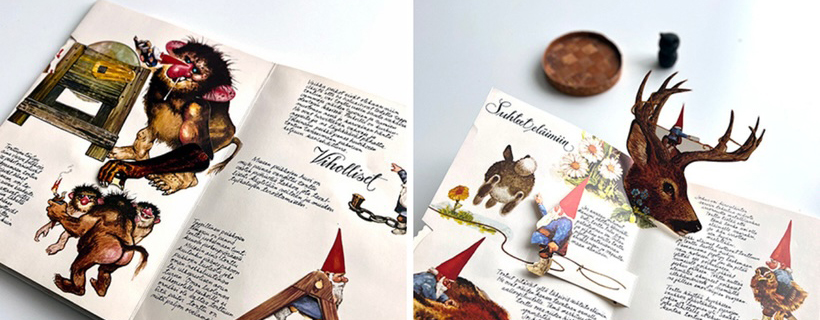
In Finnish mythology, a haltija (plural: haltijat) is a guardian spirit living in a liminal space: nature, homes, even within ourselves. The specific haltija that guards a place is called a tonttu (plural: tontut) – a newer word which comes from the Swedish “tomte.” Like the tomte (and the Norwegian/Danish nisse), a tonttu has a specific look: pointy red cap, long beard if a man, small and elflike in stature.
One of my favourite childhood keepsakes is this incredible pop-up book – “Tontut – liikkuvat, leikkivät.” I believe the title translates to “Tontut – moving, playing.” Presented as a field guide, it’s full of gorgeous illustrations and handwritten text outlining how tontut live, what they do with their days, their relationships with animals, and games they play. It even has a section called Viholliset: Enemies.
We didn’t read this book very often, largely because all the moving pieces made it so fragile. My brother and/or I inadvertently broke the part in the Enemies section where you can help the troll rotate the knife-sharpener against the tonttu. Probably for the best – as the opening line says:
Although trolls are not so evil that they would actually want to kill an elf, an elf can often suffer serious injuries at the hands of these stupid and ugly creatures.
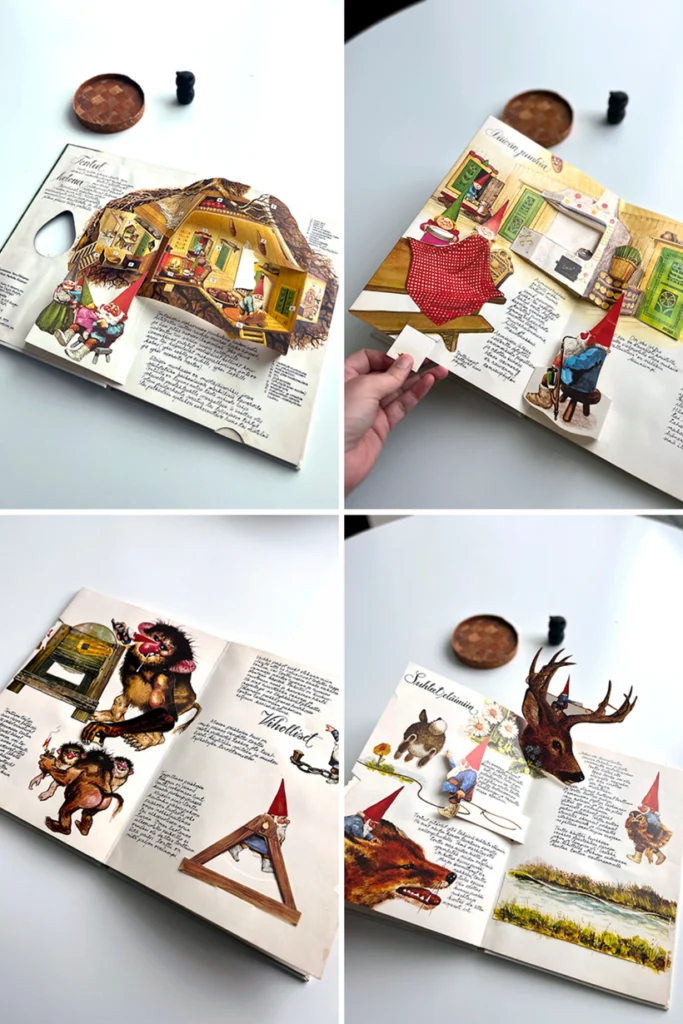
Like all haltijat, tontut require proper behaviour, respect, and sometimes ritual. They observe us closely and get upset if people act disrespectfully in their homes. Your shoes might go missing. You might hear scary noises at night. Or even worse – the tonttu might leave entirely, taking the house’s happiness with them.
To me, books like this always strike something deeper. Haltija folklore is still part of Finnish culture today. As a history-lover and as an author, I’m endlessly inspired by the stories passed down through generations. I can’t help digging deeper into them. They speak so much about what people valued, what they wanted to remember through generations. Whether I find a small snippet to share on my Patreon free tier or to use in my fiction, it’s always rewarding.
Main sources:
https://www.youtube.com/watch?v=HWLdVE1q-sc
https://scandification.com/finnish-mythology-creatures-and-finnish-folklore/
https://www.kansallismuseo.fi/en/items-of-the-month/2022/tontut
NB: I’ve made every effort to find reliable historical sources for traditions that were often not recorded until much later, if at all. Please keep in mind that I’m not a professional historian, and I’m also limited by English-language sources and the foibles of Google Translate.