In Finland, runes aren’t what you might think. At least, not in the same way. “Runo” means “poem,” and while the word is borrowed from the Proto-Germanic word, to us it’s different than the Norse futharks1.
What are “runes” in Finland, Karelia, and Estonia?
Rune-singing/runolaulu is an ancient form of oral folk poetry and storytelling from Finnish, Karelian, and Estonian culture (who are different from Scandinavians). Linguistic research suggests it’s older than the separation of Finnic languages thousands of years ago. Its structure is suited to the unique rhythm of Finnic languages.
Rune-singers sometimes held hands and sang together, but they also sang in competition. There’s spell-singing and lament-singing too. A rune-singer would follow the basics of a rune, but decided on the rhythm and content as they sang. It wasn’t mere recital – it was co-creation.
I love the idea of rune-singing as memory-keeping.
As a writer, “Finns aren’t Scandinavian” is one of the things that inspires me. Runolaulu is a perfect representation of that. Also, spell-singing appears a couple of my recent works-in-progress. It was fun to research and highlight these elements of my culture in my work.
In summer, when they are out in the forests, or tending the cattle, or making hay, they sing all the day long, just like the birds; the songs are born of themselves, the words just spring from the singers’ mouths.
Contemporary of Elias Lönnrot, compiler of folk poems that became The Kalevala
The Finnish kantele and rune-singing
My favourite instrument is the 5-string kantele. It is a very soulful and humble instrument. It teaches you to quiet your mind and allow the kantele to sing its stories – stories of hard winters and beautiful summer nights, stories of a resilient northern nation who fought hard for its independence.
Merja Soria
The kantele is an instrument inextricably linked to rune-singing in Baltic Finnic culture. Notable rune-singers were also good kantele players. The music was passed from person to person, by ear and oral tradition. They varied the pitch depending on the instrument and how the song felt.
The kantele is ancient magic, bell-like sounds plucked from story and memory. It’s fundamental to Finnish and Karelian identity, and similar instruments are found in other Baltic Finnic cultures. Kantele songs were some of the the first epic songs to be collected, and they survived longer.
“As one old man from Suojärvi was playing his endless dance tune in a log cabin that was slowly getting dark, I took a photograph, exposing the frame for a rather long time, and marvelled at how he did not blink at all, nor did he pay any attention to my photography whatsoever.”
A. O. Väisänen
I can imagine the ringing sounds of the strings, crackle of wood in the fire, the smell of coffee, shifting of feet on a wooden floor, silent breathing of people meditating on memory and story and myth. The kantele is key in my historically-inspired fantasy novels in progress. I listened to a LOT of kantele when writing and it made me emotional enough to suspect my ancestors have to be involved somehow.
“… and being asked what he was playing, he replied that it was nothing, that he was simply playing his own power.”
O. A. Hainari
The kantele in the Kalevala
The first kantele was made from the jawbone of a giant pike, hairs from the “demon” Hiisi’s horse.
That’s how the Kalevala tells it.
When Väinämönen plays it, he charms the forest, animals, and people silent.
When I include spell-song in my fantasy novels, I want it to feel like that. Soft. Wild. Ancient stories carried in the body.
1One cool thing I learned though is that Finland did have “rune staves” from the 13th century. According to the University of Helsinki, they were “wooden sticks on which a calendar for the whole year is engraved … the same stick can be used for several years.”
NB: I’ve made every effort to find reliable historical sources for traditions that were often not recorded until much later, if at all. Please keep in mind that I’m not a professional historian, and I’m also limited by English-language sources and the foibles of Google Translate.
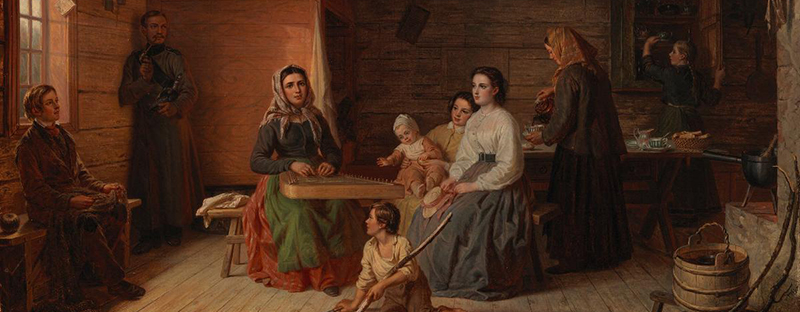
Header image: “Kreeta Haapasalo soittaa kannelta talonpoikaistuvassa/Kreeta Haapasalo Playing the Kantele in a Peasant Cottage”, Robert Wilhelm Ekman, 1868
Rune singers Iivana Onoila and Elessei Valokainen in Terijoki, 1911
Iivana Mišukka, photographed by A. O. Väisänen, 1916-1917, Finnish Heritage Agency