
On curiosity, creative research & the value of following an idea before knowing where it leads.
I’ve been thinking about the relationship between creative curiosity and usefulness: why I sometimes feel that an interesting discovery needs to become something before I’m allowed to enjoy it.
I have a habit of researching things I have no idea what to do with. A story from mythology. An old photograph. A strange footnote of everyday history. A small folk belief that reveals the way people understood the world around them.
Sometimes these things find their way into my writing – but quite often, they don’t. I go happily down a rabbit hole of research papers and websites. I discover something unexpected, go down another rabbit hole, and then it’s dinnertime and I emerge from the fog, far from where I started.
And then I wonder what the point is. Where is this going? Is it going into the novel? Could I make something from it?
I think there’s a strong temptation for a creative person to treat every interesting discovery as potential material. For me, it’s usually a curious folk belief or interesting history of everyday people. I read about something like Filipino anting-anting – magical objects bringing protection or luck – and read about Macario Sakay, a general who fought in the 1896 Philippine Revolution against American forces, who wore his anting-anting as an undershirt with written prayers and religious images. And I wonder how I might use something like that in a story. After decades of writing and making things, looking for the creative potential in whatever catches my attention has become almost second nature.
There’s nothing wrong with this, really. It’s one of the fun things about research. But sometimes I notice how quickly it can feel uncomfortable, this instinct to make something “useful” from an interesting discovery. It’s a reflex. A splinter. Before I’ve had a chance to really appreciate something I’ve learned, I’m already wondering what I can use it for. It feels unfair to the discovery, to make it work for me instead of the other way around.
I’m trying to do this less. Creative curiosity shouldn’t always produce something useful, or even have a clear outcome. Sometimes its influence is subtle, changing how we think or the questions we ask.
So I’ve been approaching it as fascination instead.
Creative curiosity and following a fascination
It’s remarkably easy to turn our interests into something useful. I get it – I had a years-long habit to start a new blog or Instagram account for every new hobby I picked up. It’s harder than ever to make money or gain visibility from our creativity, so why not focus on something we like?
But those blogs and Instagram accounts taught me something: I often didn’t know what I had to say about an interest yet, or how my relationship to it might evolve. There was something to be discovered before hauling it into the light.
I started keeping a commonplace book this year – a notebook where I write down things I’ve noticed and things I’m curious about. I don’t always spend much time pondering what I’ve written, but I often flip through it again. Sometimes I don’t know what caught my attention in the first place. I just find myself returning to something, looking at it from another angle. Maybe the reason becomes apparent eventually. Maybe it doesn’t. Making money shouldn’t be the most important end goal of creative curiosity. I’m starting to think that the time spent wondering is the real value of it.
Why does a thing fascinate me? Does it change my thinking? Does it change my instincts? Does it change me, maybe? Does it lead to something else that’s just cool? These are some of the questions I’ve started asking myself instead of how can I extract utility from this interesting thing?
These days a more exciting question for me is more like this:
What if learning about an obscure folkloric belief or a tiny moment of social history was worthwhile simply because it gave me another insight into the human experience?
How creative curiosity changes the way we see
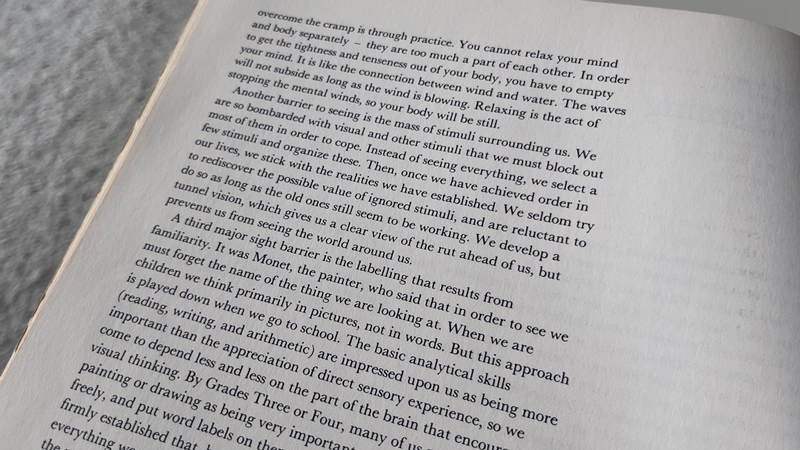
I recently thrifted a book called “Photography & The Art of Seeing” by Freeman Patterson. It appealed to me because it didn’t seem like a straightforward photography guidebook. Instead it seemed more focused on intuition, maybe even philosophy. In this book I read the following:
“It was Monet … who said that in order to see we must forget the name of the thing we are looking at.”
I wrote that sentence in my commonplace book immediately. I kept thinking about it.
In the book, the quotation illustrates how familiarity can become a roadblock to visual thinking and exploration. I think there’s a connection to creative curiosity, too. When I can put aside certain Interesting Fact Containers like a novel, a blog post or a newsletter topic, I’m able to enjoy it on its own terms.
Without that expectation, I’m more receptive to unexpected details and connections. I notice things that don’t immediately fit into an output-friendly framework. I’m allowed, quite pleasantly, to relax into the uncertainty of not knowing what something is worth to me yet.
I think this is why I continue to collect little historical and folkloric tidbits like some mad squirrel. I enjoy lining them up to see what connections emerge, if any, or simply marvelling at the things that seem to have nothing to do with anything else. Either way, I have to spend time with them before I understand why they interest me.
The value of learning for its own sake
Earlier this year I came across an article from Hungary’s Museum of Ethnography titled Serpent Stone and Bear Claw: The Mysterious Contents of a Finnish Divination Box. It explored a collection of curious objects associated with folk healers with connections to the spirit world. These objects included smooth stones, little nodules, bits of iron, juniper twigs and berries, and an unidentified claw.
Some of the stones might have been called serpent stones or raven stones. According to the article, serpent stones got their power through a mythical gathering of snakes, which passed a stone from mouth to mouth. They could then be used to treat certain skin conditions. Raven stones were associated with relieving toothache – and even conferring invisibility when held in the mouth.
I was already hooked, but then I encountered another detail. In that same article was a casual mention of “frogs found buried in tiny coffins under cathedrals,” and discovered the Finnish archaeologist Sonja Hukantaival, whose whole thing is researching and writing about ritual archaeology. I’ve read many of her papers. I can’t get enough of them.
This discovery led me to write a short Patreon essay about Finnish folklore and tietäjät (the folk healers mentioned above) and the “scrap” objects they used in healing, but it hasn’t made it into a novel. If it happens, great. I’ll welcome it. But for me, simply following a thread from raven stones that conferred invisibility to frogs buried in tiny coffins beneath Finnish cathedrals is valuable enough.
I think imagination needs variety as much as it needs material. It needs unexpected associations and details that don’t fit neatly into classifications. I like the idea that research can gradually expand our imagination, even if we don’t know what we’ll do with it.
A place for fascination
Some of these threads have somewhere else to go, too. That’s part of why I made Undone Rituals: a place for the things I keep following simply because they’re interesting. It’s an experiment in giving fascination a little room of its own, and I think it’s exactly the sort of thing my brain needs.
But I don’t want to become too good at justifying my curiosity, either. I think there’s something valuable about following a thought before you know what it’s for.
I’d rather be fascinated than useful.
If you enjoy reflections on literature, imagination, cultural curiosities, and the experience of making things, I send a monthly newsletter about what I’ve been reading, researching and thinking about. You’re welcome to join me there.